The activewear market has grown from a niche gym category into one of the fastest-moving segments in fashion, and a large share of that growth is coming from independent labels rather than legacy sportswear giants. For a new founder, that’s an opening — but starting a private label activewear brand involves more than picking a logo and a supplier off a search results page. It requires decisions about production model, fabric, minimum order quantities, and quality control that will shape the brand for years.
This guide walks through what actually needs to happen between “I want to start a private label activewear brand” and holding finished product ready to sell.
1. Decide Between Private Label and Fully Custom Production
The first fork in the road is production model. Private label means selecting from a manufacturer’s existing patterns, fits, and fabric options, then branding the finished garments as your own — leggings, sports bras, and compression shirts already engineered and tested, customized with your labels, colors, and packaging. Fully custom production means designing patterns, silhouettes, and specifications from scratch.
Private label is faster to market and typically carries lower minimum order quantities, which makes it the more practical starting point for a new brand testing demand. Fully custom production suits brands with a specific fit or performance feature that doesn’t exist in a manufacturer’s current catalog, but it takes longer and usually requires higher minimums to justify the pattern development work. Many brands start private label to validate their market, then move toward custom silhouettes once they have sales data and cash flow to support it.
2. Choose a Manufacturer, Not a Trading Company
This is the decision that determines everything downstream: quality consistency, pricing, communication, and how quickly problems get resolved when they come up. Many suppliers marketed to new brands are trading companies — they take an order and outsource production to a factory, adding a markup and a layer of communication between the buyer and the people actually making the product.
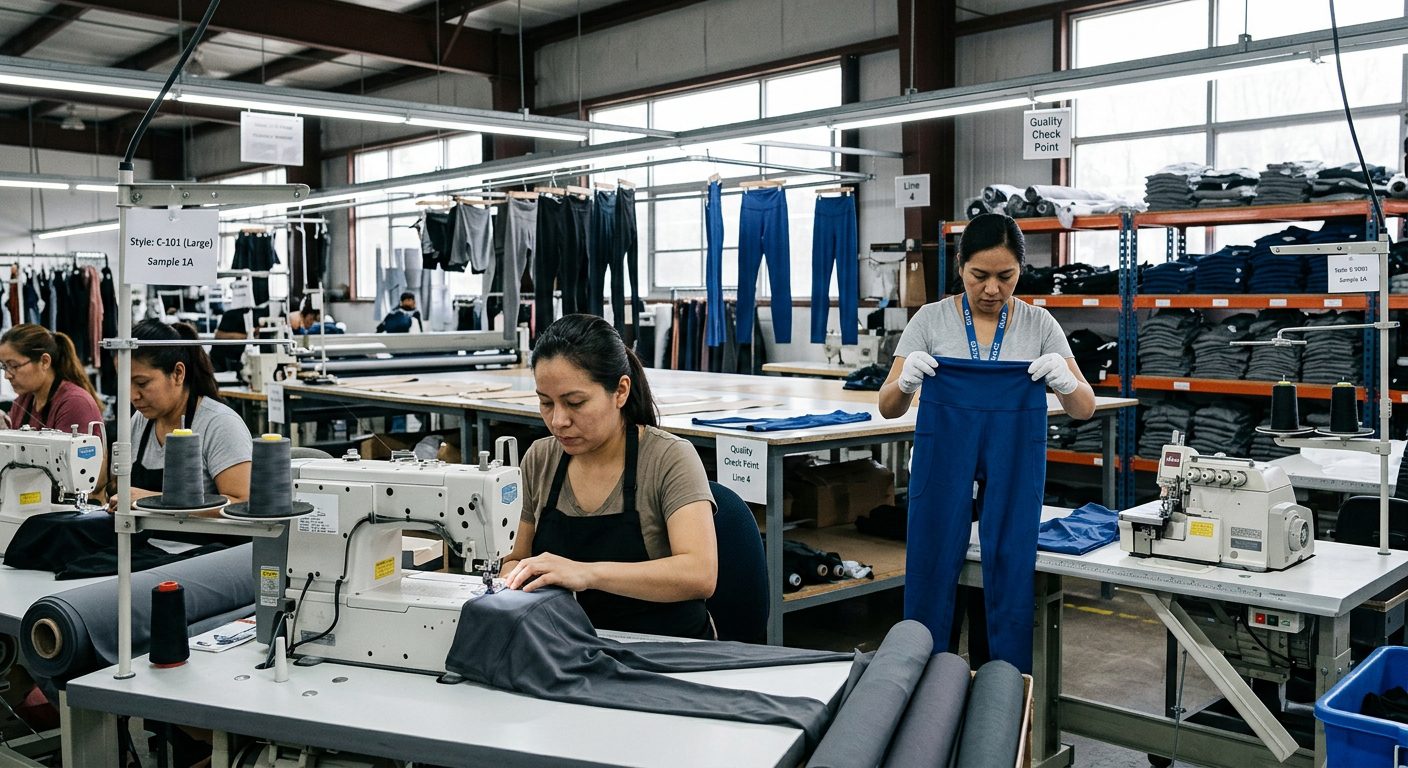
A manufacturer that produces in-house, from pattern cutting and fabric sourcing through stitching, testing, and final packing, gives a brand direct visibility into its own supply chain. That matters most when something needs to change mid-order — a fit adjustment, a fabric substitution, a size run correction — because a manufacturer can act on it directly, while a trading company has to relay the request and wait.
When evaluating a manufacturer, ask directly whether garments are produced on-site or subcontracted, and ask to see the facility’s quality control process rather than just a finished sample. A manufacturer confident in its process will walk through it without hesitation. This distinction matters most for a private label activewear brand that’s competing on consistent quality.
3. Understand Fabric Before Committing to a Fit
Fabric weight, measured in GSM (grams per square meter), determines how a garment performs, and it’s one of the most overlooked decisions new brands make. Lighter fabrics in the 180–220 GSM range suit warm-weather wear and yoga-style products where breathability matters most. Mid-weight fabrics around 220–240 GSM balance comfort and durability for general training wear. Heavier fabrics at 240 GSM and above deliver more compression, better opacity, and greater durability — the range most compression leggings and performance training gear use.
Getting this wrong is a common first-order mistake: a brand selects a fabric based on cost alone, then discovers the finished product is see-through under stretch or too warm for its intended use. A manufacturer experienced in performance fabrics should be able to recommend GSM and fabric blend based on the product’s actual use case, not just its price point.
4. Confirm Minimum Order Quantities and Sizing Standards Early
Minimum order quantities (MOQs) vary significantly between manufacturers and directly affect how much capital a new brand needs before its first sale. Confirm MOQs per style, per color, and per size run — some manufacturers quote a single blended minimum that turns out to be far higher once broken down by SKU. Getting this right early keeps a new private label activewear brand’s per-unit costs predictable.
Sizing standards should also be locked in before production starts, not adjusted after. Requesting a size-run sample or a full size set before committing to a bulk order avoids the costly mistake of receiving hundreds of units that don’t match the target market’s expectations.
5. Approve Design and Artwork Before Production Begins
Whether working private label or fully custom, no order should move to production without a design and artwork approval step. This typically means a digital mockup or a physical pre-production sample showing exact color matching, logo placement, and trim details. Branding placement — woven labels, heat transfers, embroidery, or sublimated prints — should be specified and approved in writing, since printing methods affect both cost and durability.
Sublimation, which dyes the design directly into the fabric, works best on polyester and poly-blend activewear because it won’t crack or peel with repeated washing. Screen printing sits on top of the fabric and suits smaller runs or cotton-based pieces, but shows wear over time. For most performance activewear, sublimation is the more durable choice, and it’s worth confirming which method a manufacturer specializes in before finalizing branding.
6. Plan for Quality Control and Shipping From the Start
The gap between a good sample and a consistent bulk order comes down to quality control during production, not just inspection at the end. Ask whether checks happen throughout the production run or only after the fact — continuous inspection catches stitching and fit issues before they multiply across hundreds of units.
Shipping documentation and compliance certification also need to be confirmed before the first international order, particularly for brands selling into the US, UK, EU, or Australia, where customs review can delay shipments lacking proper paperwork.
Getting Started With Your Private Label Activewear Brand
Launching a private label activewear brand comes down to a short list of decisions made correctly and early: production model, manufacturer selection, fabric weight, MOQs, and a firm approval process before bulk production. Getting these right the first time is far cheaper than correcting them after a container of product has already shipped.
Body Gear International has been manufacturing sportswear, compression wear, and activewear in-house since 2005, working with new and established brands across 80+ countries from initial consultation through delivery. For brands starting this process, get in touch to discuss fabric options, MOQs, and first sample runs.

